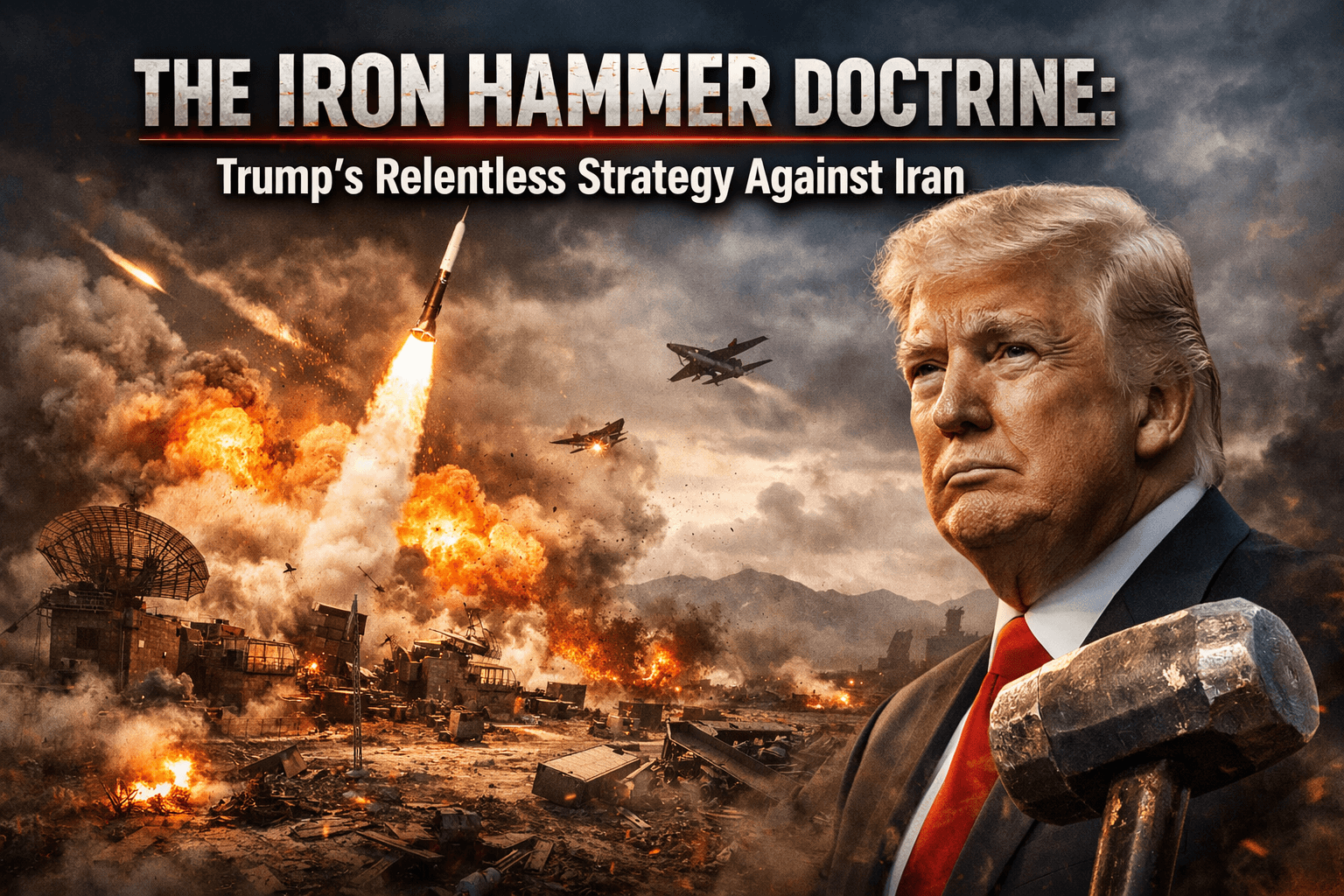

A new phase of Middle East power politics For decades the Iranian regime perfected a strategy built on one assumption: the West would always hesitate. Missiles would be tested. Proxies would attack. Militias would fire rockets. Shipping lanes would be threatened. And somewhere in Washington or Brussels another meeting would be called, another statement written, […]
For decades the Iranian regime perfected a strategy built on one assumption: the West would always hesitate.
Missiles would be tested. Proxies would attack. Militias would fire rockets. Shipping lanes would be threatened. And somewhere in Washington or Brussels another meeting would be called, another statement written, another warning issued.
Tehran learned a simple lesson from all of it the West talks.
The latest wave of U.S. and Israeli strikes targeting Iranian missile infrastructure, drone facilities, and military assets has triggered one of the most dramatic escalations in Middle East geopolitics in years. Reports indicate that key military installations, missile depots, and underground facilities have been struck as part of a coordinated effort to degrade Iran’s ability to threaten the region.
Supporters of former President Donald Trump describe the strategy in blunt terms: stop negotiating with the regime’s military machine and start dismantling it.
In their view, the era of cautious diplomacy has ended. The era of the hammer has begun.
For years critics on the political right argued that Western policy toward Iran was built on wishful thinking.
The nuclear deal negotiated during the Obama administration aimed to limit Iran’s nuclear ambitions in exchange for sanctions relief. Supporters said it prevented a nuclear crisis. Opponents said it handed billions of dollars to a regime that would continue funding proxies and expanding missile programs.
In 2018 he withdrew the United States from the nuclear agreement and launched what his administration called a “maximum pressure” campaign against Tehran reimposing sanctions and targeting the regime’s economic lifelines.
At the time, critics warned the move would destabilize the region.
Supporters argued it simply acknowledged reality: Iran’s leadership was never going to moderate its ambitions.
Now the current confrontation is being framed by many conservative voices as the next stage of that strategy — pressure not just on Iran’s economy, but on the military infrastructure that supports its regional influence.
The reason the strikes are targeting infrastructure is simple.
Iran’s missile and drone programs have become the backbone of its regional strategy.
Unlike traditional air forces, missile systems allow Iran to project power across the Middle East without needing large fleets of aircraft. Over the past two decades Tehran has invested heavily in ballistic missiles, cruise missiles, and long-range drones capable of reaching targets across the region.
Those weapons have been used directly and through proxy forces in conflicts stretching from Yemen to Iraq and Syria.
To supporters of the current air campaign, that network represents the real threat.
Destroy the missile sites. Destroy the launch facilities. Destroy the command networks that control them.
And the regime’s ability to threaten the region begins to collapse.
Trump’s supporters see the strikes not as random escalation but as a strategy built on deterrence.
The idea is brutally simple.
If Iran builds a missile base, it becomes a target. If Iran expands drone factories, they become targets. If Iran threatens regional shipping lanes or military bases, the infrastructure behind those threats becomes a target.
In conservative political circles this approach has earned a blunt nickname: the Iron Hammer Doctrine.
The logic is that deterrence only works when adversaries believe the consequences are real.
For decades Iran tested the limits of Western patience. Now the message being sent by supporters of the strikes is equally clear.
Keep building the infrastructure of conflict, and it will keep getting destroyed.
Not surprisingly, critics of the strategy see something very different.
Many foreign policy analysts warn that sustained strikes inside Iran risk triggering a wider regional war that could pull in multiple countries and destabilize global energy markets.
Iran has already demonstrated its ability to retaliate using missiles, drones, and proxy militias across the region.
Escalation could threaten shipping through the Strait of Hormuz a chokepoint for global oil supplies.
It could also draw additional powers into the conflict.
For critics, the concern is that once direct military confrontation between Iran and Western allies becomes normalized, it may be extremely difficult to contain.
In other words, once the hammer starts swinging, it may not stop.
Regardless of where one stands politically, the strategic landscape is clearly shifting.
For decades the confrontation between Iran, Israel, and the United States played out largely in shadows — covert operations, cyber warfare, proxy conflicts.
Missiles are launched. Air defenses are activated. Military facilities are destroyed in real time.
And the political rhetoric surrounding it is becoming just as direct.
Supporters say the strategy restores deterrence and forces Tehran to confront consequences it avoided for years.
Critics warn that the approach risks replacing unstable diplomacy with open war.
The old playbook warnings, negotiations, and incremental pressure appears to be fading.
In its place is something far more blunt.
A strategy built on the belief that if a regime keeps building threats, the only answer is to keep smashing them.
The hammer, in other words, is no longer symbolic.
It’s policy..
-1-300x200.png&w=3840&q=75)
Visa is quietly moving stablecoins into the back office of money
1 min read · 30 Apr 2026
-300x200.png&w=3840&q=75)
Europe’s mythos problem is really a security problem
1 min read · 21 Apr 2026
-300x200.png&w=3840&q=75)
SpaceX’s Cursor move is not just about buying a startup
1 min read · 21 Apr 2026

YouTube’s Creator Future Is Starting to Look Less Like Hollywood and More Like a High End Home Studio Economy
1 min read · 29 Mar 2026

Wall Street’s Tokenization Rush Is Not a Crypto Victory, It Is a Rewrite of Finance Designed to Keep the Old Gatekeepers in Charge
1 min read · 29 Mar 2026

India’s Semaglutide Shock Could Redraw the Global Weight Loss Drug Market
1 min read · 28 Mar 2026

Milady, Loyalty, and Ethereum’s Identity Fight Are Exposing a Much Deeper Cultural Split
1 min read · 28 Mar 2026

David Sacks Leaves the White House With a Crypto Record That Helped Banks More Than Bitcoin
1 min read · 28 Mar 2026

XRP ETFs Just Flipped. And That Shift Might Matter More Than The Rally
1 min read · 27 Mar 2026
One Nation’s New Surge Looks Bigger Than a Protest Spike Because the Structural Cracks in Australian Politics Are Getting Harder to Ignore
1 min read · 27 Mar 2026