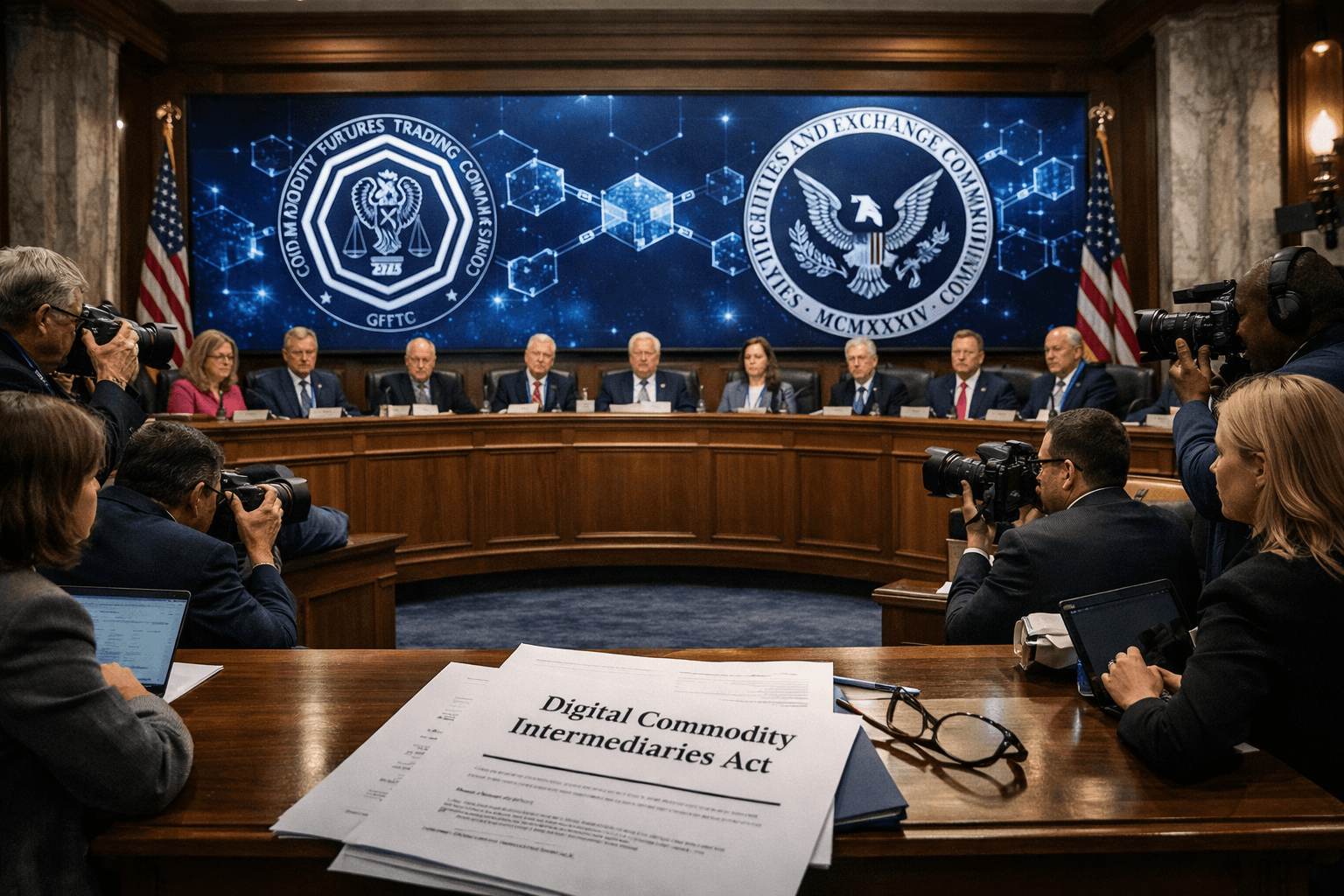

What This Means for the Future of Digital Assets On January 29, 2026, the U.S. Senate Agriculture Committee voted to advance a landmark cryptocurrency regulation bill designed to establish clear federal authority for regulating digital assets in the United States. The legislation, known as the Digital Commodity Intermediaries Act, would grant the Commodity Futures Trading […]
On January 29, 2026, the U.S. Senate Agriculture Committee voted to advance a landmark cryptocurrency regulation bill designed to establish clear federal authority for regulating digital assets in the United States. The legislation, known as the Digital Commodity Intermediaries Act, would grant the Commodity Futures Trading Commission (CFTC) primary regulatory oversight over digital commodities and their markets, a major step in clarifying rules that have long been ambiguous for the crypto industry.
This advancement marks the first time in U.S. history that a comprehensive crypto market structure bill has cleared a Senate committee, highlighting a potential turning point in how digital assets are governed at the federal level. However, while the vote was a historic moment, the path ahead is far from smooth.
Digital asset markets have grown rapidly in recent years, but U.S. regulators have struggled to keep pace. Already in 2025, the GENIUS Act was enacted into law to regulate stablecoins by requiring them to be backed one for one by reliable assets and providing transparency and audit standards laying early groundwork for crypto oversight.
Despite that progress, market participants and lawmakers have repeatedly pointed to a lack of clarity around regulatory jurisdiction particularly about which federal agency oversees which type of digital asset. Traditional financial instruments such as securities are regulated by the Securities and Exchange Commission (SEC), while the CFTC was established in 1974 to regulate futures, swaps and other derivatives. Yet until now, there has been no clear statutory authority designating how digital assets should be treated.
The Digital Commodity Intermediaries Act now offers a framework to finally resolve this ambiguity. Under the bill, the CFTC would have clear regulatory authority over digital commodities, including cryptocurrencies like Bitcoin and other decentralized tokens that fall outside traditional securities definitions.
The Agriculture Committee marked up the bill on a 12–11 party line vote, with all Republican members voting in favor and Democrats opposing the measure. This outcome underscores the political divisions surrounding how best to regulate digital asset markets.
The committee report reflects a mix of compromise and contention. Chairman John Boozman (R-Arkansas) emphasized that advancing the bill is a critical step toward protecting consumers and fostering innovation. He highlighted provisions that would introduce clear legal definitions for digital commodities, establish registration requirements for intermediaries, strengthen consumer protections and facilitate coordination between the CFTC and SEC.
However, Democratic lawmakers raised serious concerns. Some expressed objections to the bill’s lack of provisions addressing decentralized finance (DeFi), ethical safeguards regarding public officials and protections against political profiteering. They also argued that certain critical industry issues were inadequately addressed leading to a unified Democratic “no” vote.
The Digital Commodity Intermediaries Act is not simply a regulatory expansion; it is an effort to redefine the legal landscape for digital assets:
Clear Definitions: The bill incorporates precise legal definitions of digital commodities and categories of intermediaries that will fall under CFTC oversight. This clarity is crucial for both regulators and market participants.
Registration and Compliance: Digital commodity exchanges, brokers and dealers would be required to register with the CFTC. The bill provides for an expedited registration process and a provisional status for firms until final rules are adopted.
Consumer Protection: The legislation would require customer fund segregation, mandatory disclosures and conflict of interest safeguards to protect retail investors.
Interagency Coordination: The bill calls for joint rulemaking between the CFTC and SEC in areas where their jurisdictions overlap, helping avoid duplication and regulatory conflict.
Developer Protections: Software developers working on blockchain systems or protocols would receive limited protections from coverage, while still being subject to safeguards against fraud or manipulation.
While advancing through the Agriculture Committee is historic, the bill is far from becoming law. The next crucial step is approval by the Senate Banking Committee, which is responsible for the portions of the market structure bill related to securities and investment contracts. The two bills agriculture and banking must eventually be reconciled before a full Senate vote.
Another political hurdle lies in winning support from a sufficient number of Senate Democrats. To pass the full Senate and reach the President’s desk, the legislation will need at least seven Democratic votes, given the current Senate layout.
Industry reaction has been mixed. Many in the crypto sector welcome the move towards legal certainty, arguing that clearer regulations are vital for growth and innovation. Some firms believe well-defined rules could encourage institutional participation and long-term investment in digital markets.
Meanwhile, regulators outside of Congress appear to support the shift toward clarity. SEC Chair Paul Atkins and CFTC Chair Mike Selig recently signaled a cooperative tone, suggesting that clearer statutory roles will help both agencies oversee markets more effectively and may help bring pension and institutional capital into crypto markets.
The lack of clear federal guidelines has been a major barrier for U.S. crypto firms operating in a global ecosystem where other jurisdictions are rapidly defining rules of the road for digital assets. Without a comprehensive framework, innovators face uncertainty, and investors lack consistent protections.
By advancing the Digital Commodity Intermediaries Act, Congress is taking a major stride toward legal clarity and regulatory structure that could shape the future of digital finance. If successfully enacted, the bill could not only provide a predictable environment for businesses and investors but also position the U.S. as a leader in digital asset markets.
Before this legislation becomes law:
Senate Banking Committee must approve its version and then merge it with the agriculture bill.
Negotiations over stablecoin yield and DeFi safeguards must be resolved as part of broader regulatory discussions.
The full Senate must vote, requiring bipartisan support to surpass filibuster thresholds.
As lawmakers continue to debate and refine the proposal, digital asset markets in the U.S. could be on the brink of a new regulatory era one with clearer rules and more robust investor protections.

Iran’s Five Demands Show This War Is Moving Further From Peace, Not Closer
1 min read · 25 Mar 2026

A $200 Billion Iran War Bill Shows Just How Big The Stakes Have Become
1 min read · 23 Mar 2026

War Between the U.S., Israel, and Iran Escalates as Conflict Enters Third Week
1 min read · 16 Mar 2026

Venice Biennale Under Fire Over Russian Presence
1 min read · 14 Mar 2026

Iran War Spending Equals Half the Value of the U.S. Bitcoin Reserve in Just Six Days
1 min read · 14 Mar 2026

Prosecutors Push to Retry Tornado Cash Co-Founder Even as Washington Softens on Crypto Privacy
1 min read · 12 Mar 2026

Forget CPI and ETFs Oil Prices May Now Be the Biggest Signal for Bitcoin
1 min read · 8 Mar 2026

How SK Telecom Is Rebuilding Itself Around AI at MWC 2026
1 min read · 3 Mar 2026

Dubai and the UAE on the Frontlines: How the Iran Israel Conflict Has Reverberated Across a Global Hub
1 min read · 3 Mar 2026

US and Israel Military Strikes on Iran and the Escalation of Conflict in the Middle East
1 min read · 28 Feb 2026