

How Jurisdictional Design, Not Deregulation, Is Reshaping the Future of Retail Finance In 2025, Robinhood’s strategy stopped looking like a simple expansion plan and started to resemble something more deliberate: a jurisdictional architecture designed to achieve outcomes that are structurally blocked in the United States. Rather than lobbying aggressively to change U.S. law, Robinhood has […]
In 2025, Robinhood’s strategy stopped looking like a simple expansion plan and started to resemble something more deliberate: a jurisdictional architecture designed to achieve outcomes that are structurally blocked in the United States. Rather than lobbying aggressively to change U.S. law, Robinhood has been building what analysts describe as a regional triangle spanning the United States, Europe, and Asia that allows the company to offer features, products, and financial primitives globally that U.S. regulators will not currently permit domestically. The result is not regulatory arbitrage in the traditional sense, but a more subtle form of regulatory geometry, where location determines what financial innovation is possible.
At the center of this strategy is a hard reality: U.S. regulators remain deeply resistant to retail access to yield-bearing, tokenized, or self-custodial financial products, especially when those products blur the lines between securities, banking, and crypto. Despite years of debate, American retail users are still largely blocked from earning native yield on digital assets, holding tokenized securities in self-custody, or accessing crypto-native financial instruments without intermediaries. Robinhood’s response has not been to fight this head-on, but to route around it.
The “triangle” takes shape as follows. The United States remains Robinhood’s core retail on-ramp, providing scale, brand trust, and a massive user base but with limited product depth. Europe functions as the experimentation zone, where clearer crypto frameworks and passportable financial licenses allow Robinhood to offer tokenized assets, custody-light products, and yield-adjacent features. Asia, particularly crypto-forward hubs, acts as the liquidity and infrastructure layer, where trading, settlement, and digital asset rails can operate with fewer constraints. Together, these regions form a closed loop where users, capital, and functionality move even if no single jurisdiction allows the full stack on its own.
What U.S. regulators “won’t permit” is not crypto per se, but the convergence of three things in one place: retail access, yield, and self-custody. American policy has drawn firm lines around each. Yield belongs to banks. Custody belongs to regulated intermediaries. Tokenization belongs in legal gray zones. Robinhood’s regional triangle allows these components to exist just not all under U.S. soil at the same time. The user experience, however, increasingly feels seamless, which is precisely the point.
This matters because finance is no longer bounded by geography the way regulation is. A Robinhood user in the U.S. may interact with a clean, compliant interface, but behind the scenes, value flows through European entities, settles via global crypto rails, and interfaces with markets outside U.S. jurisdiction. Nothing illegal is happening, yet the outcome broader financial capability would be impossible if everything were forced to remain domestic. The triangle doesn’t break rules; it exposes their limits.
For Robinhood, this is also a survival strategy. The company learned painful lessons after the meme-stock era, when regulatory scrutiny intensified and growth stalled. Relying solely on U.S. equities trading proved fragile. Crypto, tokenization, and global markets offer higher-margin, always-on activity but only if the company can operate in environments that permit it. Europe’s more explicit crypto frameworks and Asia’s infrastructure openness give Robinhood room to innovate without waiting years for Washington to decide what crypto is allowed to be.
Critically, this is not just about crypto trading. The deeper prize is financial composability the ability for assets to move, earn, settle, and be programmed without friction. In the U.S., this vision runs into regulatory walls almost immediately. In Europe, tokenized funds and digital asset custody have clearer pathways. In parts of Asia, settlement and liquidity operate at internet speed. By linking these regions, Robinhood effectively reconstructs a financial system that feels modern, even if no single regulator would approve it end-to-end.
This has broader implications for U.S. financial policy. If enough major platforms adopt similar architectures, the center of financial innovation will drift outward, not because the U.S. banned it explicitly, but because it made it impractical to build locally. Over time, American users may still participate but increasingly as endpoints, not origin points. That shift carries long-term consequences for competitiveness, talent, and capital formation.
From the user’s perspective, the change is subtle but powerful. Features appear incrementally: token exposure here, crypto custody there, yield-like incentives framed as rewards rather than interest. Each step is compliant in isolation. Together, they approximate what regulators have tried to prevent: a retail financial system that bypasses banks, operates globally, and runs on digital rails. The triangle doesn’t advertise this openly, but its architecture makes the direction clear.
There are risks. Jurisdictional complexity increases operational fragility. Regulatory coordination failures could create gaps or sudden restrictions. Political pressure could force retrenchment. And critics argue that this model privileges companies with scale while leaving smaller innovators behind. Still, the direction of travel seems set. If regulation cannot move fast enough, geography will move around it.
In that sense, Robinhood’s strategy is less about defiance and more about adaptation. The company is not betting that U.S. regulators will suddenly reverse course. It is betting that global finance will continue to fragment, and that firms capable of stitching those fragments together will define the next era of retail finance. The regional triangle is not a loophole it is a blueprint for how modern financial platforms may operate in a world where rules remain national but markets are irreversibly global.
Ultimately, Robinhood’s construction of this triangle highlights a central tension of the current moment: regulators still think in borders, while capital thinks in networks. Until those two perspectives align, the most innovative financial products will continue to emerge not from deregulation, but from strategic geography.

Iran’s Five Demands Show This War Is Moving Further From Peace, Not Closer
1 min read · 25 Mar 2026

A $200 Billion Iran War Bill Shows Just How Big The Stakes Have Become
1 min read · 23 Mar 2026

War Between the U.S., Israel, and Iran Escalates as Conflict Enters Third Week
1 min read · 16 Mar 2026

Venice Biennale Under Fire Over Russian Presence
1 min read · 14 Mar 2026
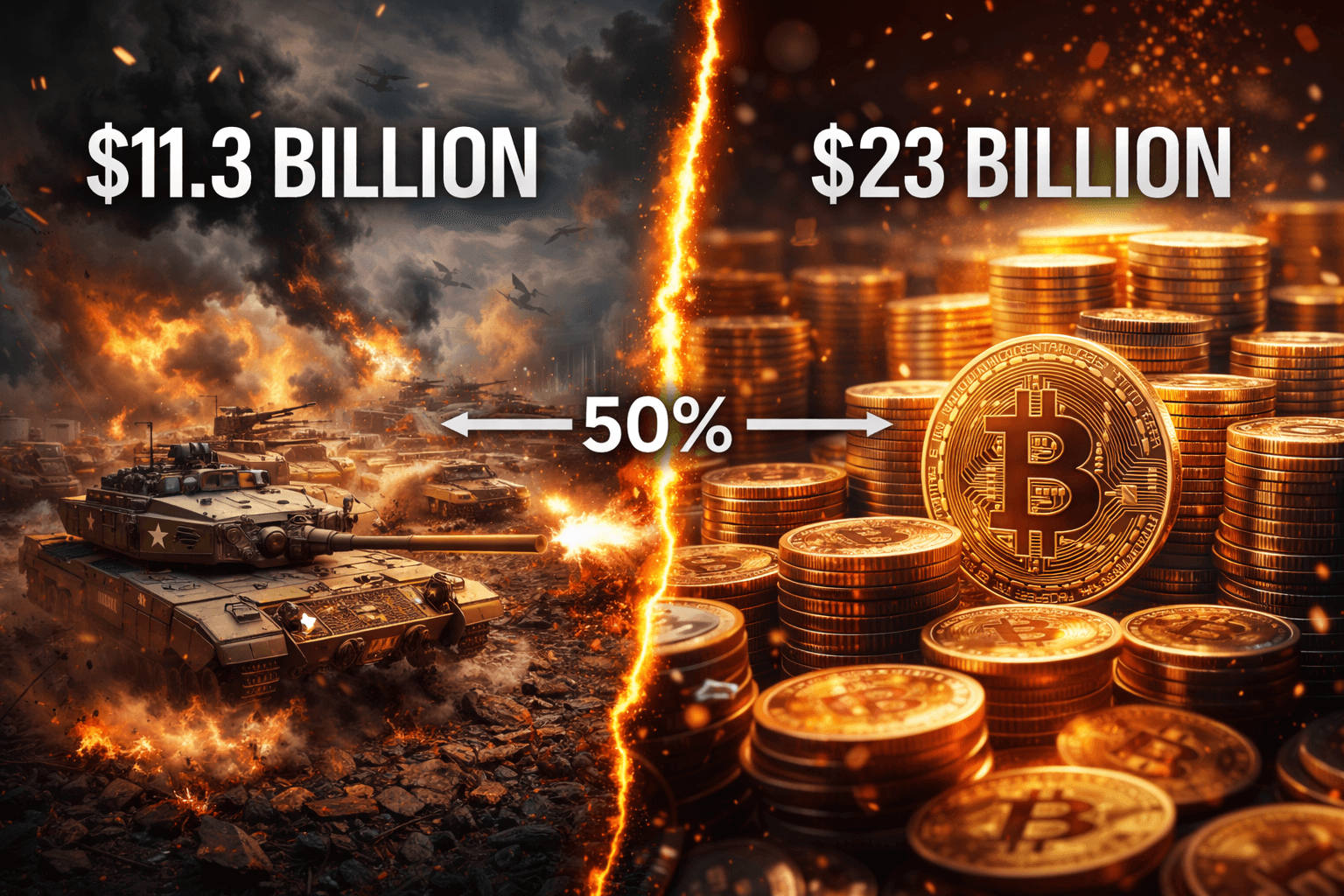
Iran War Spending Equals Half the Value of the U.S. Bitcoin Reserve in Just Six Days
1 min read · 14 Mar 2026

Prosecutors Push to Retry Tornado Cash Co-Founder Even as Washington Softens on Crypto Privacy
1 min read · 12 Mar 2026

Forget CPI and ETFs Oil Prices May Now Be the Biggest Signal for Bitcoin
1 min read · 8 Mar 2026

How SK Telecom Is Rebuilding Itself Around AI at MWC 2026
1 min read · 3 Mar 2026

Dubai and the UAE on the Frontlines: How the Iran Israel Conflict Has Reverberated Across a Global Hub
1 min read · 3 Mar 2026

US and Israel Military Strikes on Iran and the Escalation of Conflict in the Middle East
1 min read · 28 Feb 2026