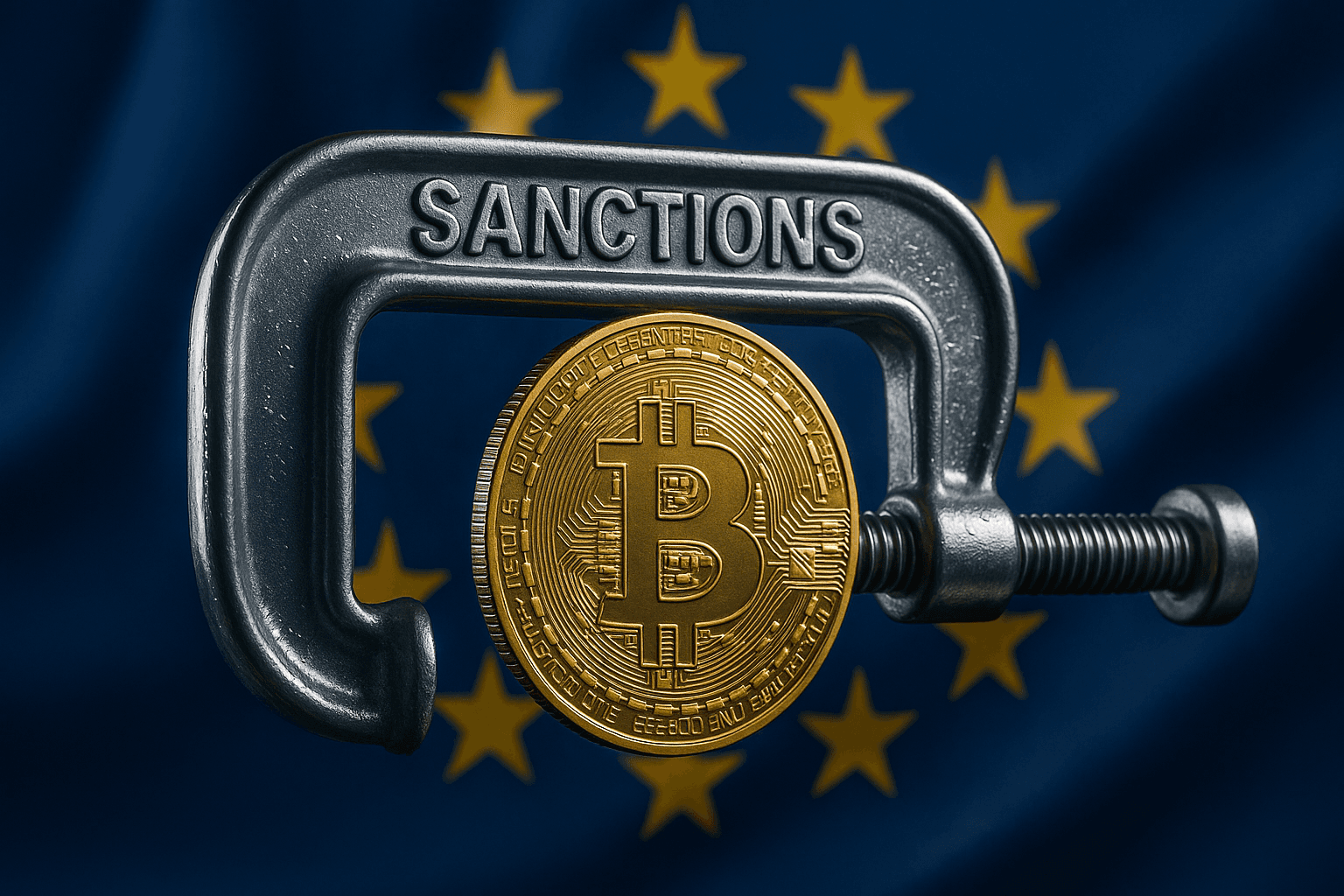

Will EU sanctions choke ruble stablecoin routes into Bitcoin? EU sanctions aren’t a blanket ban on Bitcoin or stablecoins, but they’re steadily tightening the rules around who can use crypto rails connected to Russia and how. The basic route under scrutiny is simple convert rubles into a stablecoin (often USDT), then swap into Bitcoin via […]
EU sanctions aren’t a blanket ban on Bitcoin or stablecoins, but they’re steadily tightening the rules around who can use crypto rails connected to Russia and how. The basic route under scrutiny is simple convert rubles into a stablecoin (often USDT), then swap into Bitcoin via exchanges, OTC desks, or peer to peer markets. Sanctions aim to raise the friction at every chokepoint with stronger KYC, wallet screening, and penalties for platforms that ignore red flags.
We’ve already seen how enforcement bites in practice. After European action against the Russia linked exchange Garantex, Tether froze wallets tied to sanctioned activity proof that large stablecoin issuers will act when regulators move.
Big exchanges have also de risked winding down ruble pairs, cutting RUB deposits, and pruning P2P listings. None of this “turns off” crypto, but it removes the most convenient, liquid bridges that used to make ruble to stablecoin conversion easy.
Pressure on mainstream dollar stablecoins has pushed activity toward alternatives, including ruble backed tokens like A7A5. Reports throughout 2025 describe rapid growth in these instruments for cross border payments and as stepping stones into other assets.
The numbers vary by source, but the trend is clear traffic doesn’t disappear when one door closes it shifts to less visible routes and smaller venues where Western jurisdiction bites less.
That shift creates a thorny compliance problem indirect exposure. Funds can bounce from a ruble linked token into a dollar stablecoin on a DEX, then land at a Western exchange looking “clean” unless you trace every hop. In response, the EU keeps pushing end to end analytics and tougher onboarding. The result is more blocked deposits and freezes, higher costs for would be evaders, and a steady deterrent effect especially for actors who need access to EU touching infrastructure.
Still, the real economy incentive behind these flows settling trade, especially energy and commodities hasn’t gone away. That’s why we should expect ongoing cat and mouse dynamics: more freezes and delistings on the one hand; on the other, quick pivots to ruble backed or non USD stablecoins, OTC deals, regional networks, and multi hop DEX paths designed to stay a step ahead of screening tools. Think of it less as a wall and more as a maze that keeps getting longer and harder.
Bottom line EU sanctions do “choke” the most visible, high liquidity ruble to Bitcoin routes by making them slower, costlier, and riskier. They don’t eliminate the demand or the ingenuity behind alternative rails. Over time we get fragmentation smaller venues, messier paths, worse user experience rather than a clean shutdown.
That’s meaningful it reduces scale and convenience, which is where policy can realistically bite, even if the underlying incentives keep the flows alive.
-300x200.png&w=3840&q=75)
Banks, stablecoins, and the CLARITY Act
1 min read · 22 Apr 2026

Wall Street’s Tokenization Rush Is Not a Crypto Victory, It Is a Rewrite of Finance Designed to Keep the Old Gatekeepers in Charge
1 min read · 29 Mar 2026

Ipswich, Farage, and the Football Backlash That Shows Why Clubs Cannot Hide Behind Neutrality Foreve
1 min read · 28 Mar 2026
David Sacks Leaves the White House With a Crypto Record That Helped Banks More Than Bitcoin
1 min read · 28 Mar 2026

Iran’s Information War Is Targeting America and It’s Already Working
1 min read · 27 Mar 2026
Washington’s Crypto Power Shift Is Real, and It Could Redraw the Rules Fast
1 min read · 26 Mar 2026

Europe’s Deportation Turn Did Not Happen Overnight
1 min read · 25 Mar 2026

Iran’s Five Demands Show This War Is Moving Further From Peace, Not Closer
1 min read · 25 Mar 2026

Gavin Newsom’s Patrick Bateman Joke Wasn’t Clever. It Was Revealing.
1 min read · 25 Mar 2026

Britain’s Social Media Ban Trial Is Really A Test Of State Confidence
1 min read · 25 Mar 2026