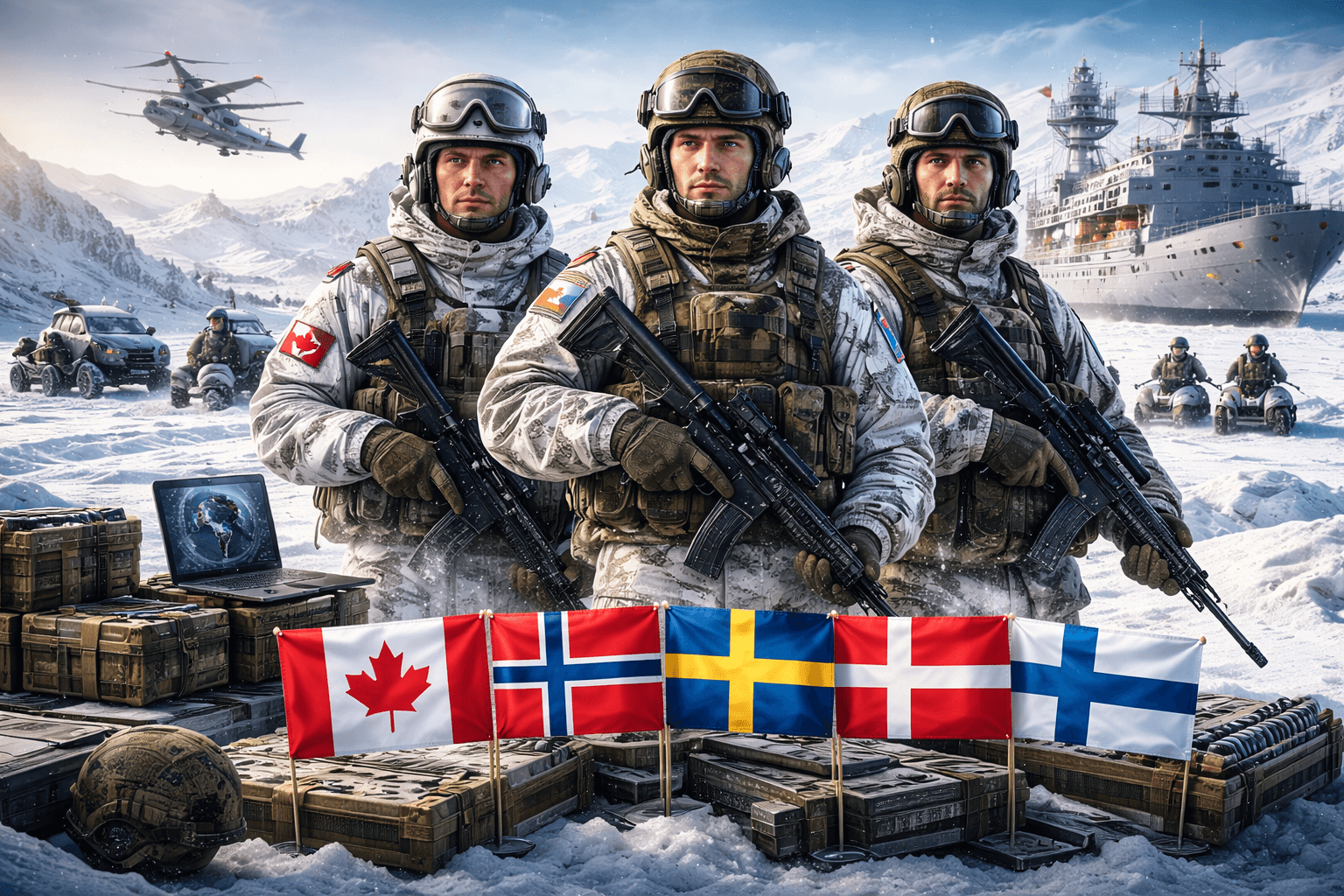

New alliance aims to strengthen security in the rapidly changing Arctic Canada is strengthening its ties with Nordic countries as global tensions and competition in the Arctic continue to rise. The new cooperation focuses on defence production, military procurement, and Arctic security, marking a major step toward deeper strategic alignment between Canada and the Nordic […]
Canada is strengthening its ties with Nordic countries as global tensions and competition in the Arctic continue to rise. The new cooperation focuses on defence production, military procurement, and Arctic security, marking a major step toward deeper strategic alignment between Canada and the Nordic region.
The agreement was announced following high-level meetings between Canadian officials and leaders from Nordic nations including Norway, Sweden, Finland, Denmark, and Iceland. Together, the countries committed to expanding collaboration in military-industrial production and security planning in the Arctic.
The Arctic is becoming one of the most strategically important regions on the planet. Melting sea ice is opening new shipping routes, access to natural resources, and expanded military presence, drawing the attention of major powers such as Russia and China.
For Canada and Nordic states many of which share Arctic territory the changing landscape is creating both opportunity and risk. Governments increasingly see Arctic security as directly tied to national sovereignty and economic stability.
As a result, the new partnership focuses on strengthening defence capabilities and building resilient military supply chains across allied countries.
A key part of the agreement is closer collaboration in defence manufacturing and procurement. By coordinating production, Canada and Nordic countries aim to expand military capacity while reducing dependence on outside suppliers.
Officials say cooperation could include:
joint defence procurement programs
shared research and development
collaboration on aerospace, artificial intelligence, and critical minerals
expanding defence industrial capacity among allied economies.
The goal is to create a stronger network of “middle-power” nations capable of supporting each other’s defence needs while maintaining technological independence.
The partnership also aligns closely with NATO security efforts in the Arctic.
Canadian leaders recently participated in Cold Response, a large NATO exercise held above the Arctic Circle designed to test military readiness and interoperability between allied forces.
Such exercises allow Arctic nations to practice operations in extreme conditions and coordinate responses to potential security threats.
Canada also conducts its own Arctic exercises, including Operation Nanook, which demonstrates the country’s ability to operate and defend its northern territory.
The cooperation reflects Canada’s broader strategy of building stronger alliances with like-minded countries.
By working with Nordic partners, Canada hopes to create a network of technologically advanced democracies that can jointly respond to security challenges in the High North.
The collaboration extends beyond defence as well. Leaders have also discussed expanding partnerships in space technology, digital innovation, and critical minerals, all areas increasingly tied to national security and economic resilience.
With climate change reshaping the Arctic and global powers competing for influence in the region, the partnership between Canada and the Nordic countries signals a new phase of strategic cooperation.
For Canada, the message is clear: protecting Arctic sovereignty will require stronger alliances, advanced technology, and a defence industry capable of supporting operations in one of the harshest environments on Earth.
The Arctic may once have been considered remote and inaccessible.
Today, it is quickly becoming one of the most important geopolitical frontiers of the 21st century.
-2-300x200.png&w=3840&q=75)
CLARITY Act vote moves crypto from lobbying fight to Senate floor test
1 min read · 15 May 2026
-300x200.png&w=3840&q=75)
XRP scam surge shows crypto’s trust problem is getting more professional
1 min read · 14 May 2026
-300x200.png&w=3840&q=75)
The CLARITY Act fight is really about who controls the next layer of digital money
1 min read · 13 May 2026
-2-300x200.png&w=3840&q=75)
AI’s Last Mile Is Not Better Models, It Is Cheaper Workflows
1 min read · 12 May 2026
-300x200.png&w=3840&q=75)
JPMorgan Is Building A Cash Stack, Not Picking A Blockchain Winner
1 min read · 12 May 2026

Circle’s Arc push shows the stablecoin war is moving from tokens to infrastructure
1 min read · 12 May 2026
-300x200.png&w=3840&q=75)
The stablecoin rewards fight is really about who controls the next customer dollar
1 min read · 11 May 2026
-2-300x200.png&w=3840&q=75)
The CLARITY Act now depends on seven Democrats and the politics of trust
1 min read · 11 May 2026
-2-300x200.png&w=3840&q=75)
DeFi’s $16.5 Billion Security Bill Is Forcing Crypto To Grow Up
1 min read · 11 May 2026
-300x200.png&w=3840&q=75)
Chainlink’s $3 Billion DeFi Moment Shows Security Is Becoming Crypto’s New Growth Engine
1 min read · 10 May 2026