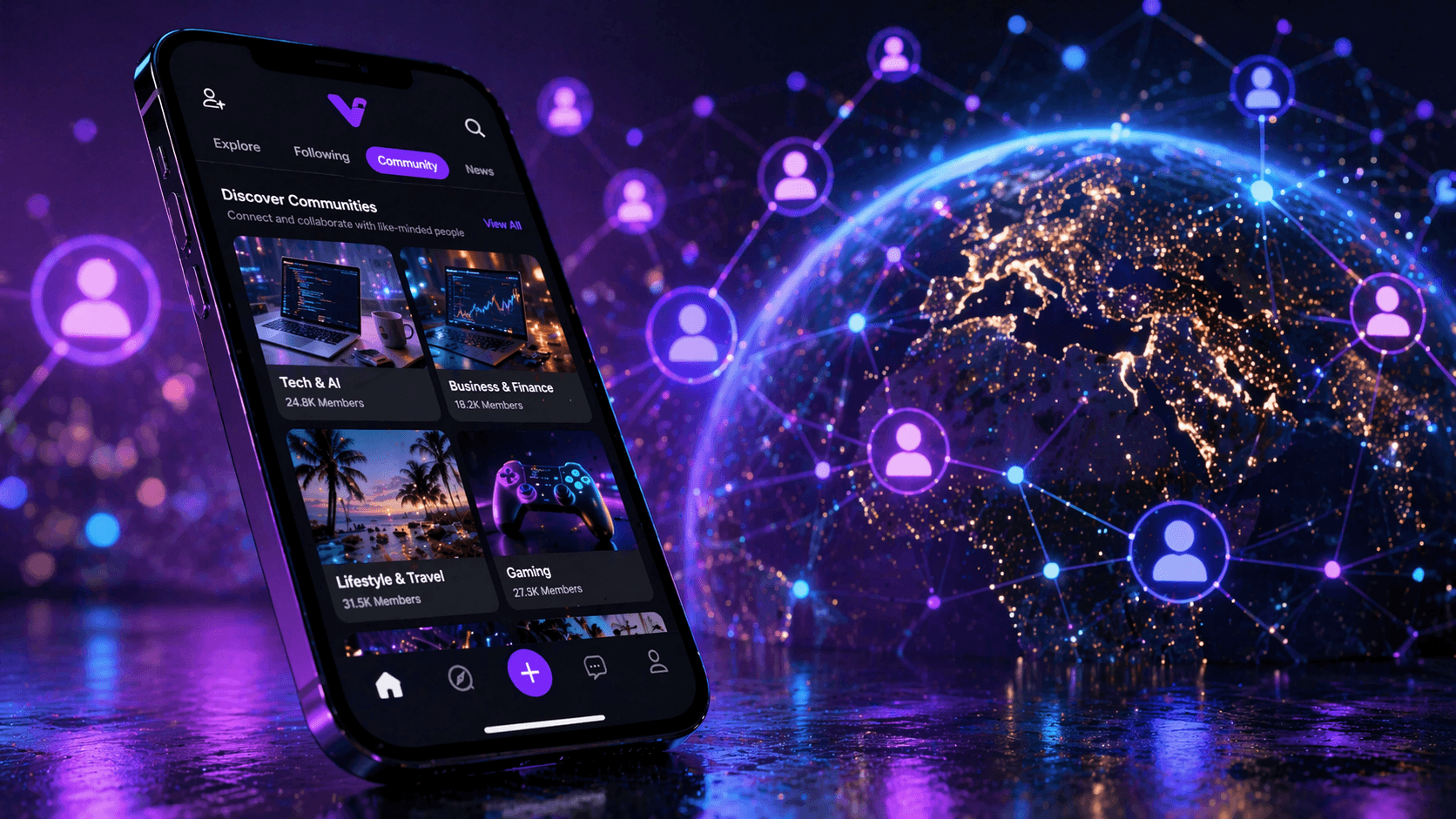

A wide cinematic social media themed image showing a glossy AI-style influencer image on a phone screen contrasted with a more grounded online community space, highlighting the tension between synthetic attention, digital performance, and real human trust.
There was always something a bit slippery about social media. Even before generative AI arrived, the feed was full of polished lives, staged moments, edited faces, rented luxury, borrowed status, and captions designed to make normal people feel like they were missing the best party on earth. That was already the game. What AI has done is pour rocket fuel on it. Now the same fantasy can be produced faster, cheaper, and at a scale that makes the old influencer economy look almost handmade. Recent reporting around Coachella showed AI-generated influencers posting glossy festival images, celebrity-adjacent moments, and believable event shots that were convincing enough to fool plenty of viewers, especially in a fast scroll. Some accounts disclosed what they were. Some hid behind mushy labels like “digital creator.” Some appeared to rely on the fact that many people either would not notice or would not care.
That is why this matters. This is not really a story about one festival in the California desert. It is a story about the next stage of persuasion online. The old internet rewarded whoever could make the strongest impression. The new internet may reward whoever can fake believability at industrial scale. That is a very different kind of contest. It is not only about reach anymore. It is about whether audiences still feel they can trust what they are looking at, and whether platforms built around real people, recurring conversation, and interest-based communities might end up holding more value than the biggest, glossiest public feeds.
What makes the current moment so interesting is that the economics are obvious. A synthetic influencer does not need flights, festival tickets, hotel bookings, brand handlers, makeup, transport, reshoots, or perfect timing. It can be endlessly available, endlessly beautiful, endlessly adjustable, and endlessly repurposed for whatever trend is breaking that week. That makes AI influencers catnip for marketers, creators, and grifters alike. Yet the market is not charging into this blindly. Research from the World Federation of Advertisers found that only 15 percent of its members had tested AI influencers and 60 percent had no plans to, even though the appeal around cost efficiency and scalability was strong. In the same research, 96 percent cited concerns around consumer trust and acceptance. That is the whole game in one snapshot. Cheap attention is exciting. Trust is expensive.
That tension is exactly where the next social platforms could be won or lost. If the main feed becomes a synthetic performance hall where nobody is quite sure who is real, then the value starts shifting somewhere else. It shifts toward places where identity is clearer, context is stronger, relationships are more repeated, and people have a reason to return other than random spectacle. That is where communities come in, and it is also why platforms that are building around communities, including V Social, may have a real opening if they get the culture right. V Social’s public product structure already separates Explore, Following, Community, and News, and its Communities section invites users to discover and join communities across categories like tech, business, lifestyle, travel, gaming, education, and more. That structure matters because it suggests a different social model from pure feed chasing.
One mistake people make is pretending that AI influencers broke an honest system. They did not. The system was already leaning in this direction. Coachella is the perfect example because it has long been one of the internet’s clearest performance zones. It is a real music festival, of course, but it is also a giant cultural set piece for branding, fashion, attention, and envy. Recent reporting described AI influencers posting festival content and even apparent celebrity proximity shots that looked believable enough to blend into the event’s usual social flood. It also noted that faking Coachella attendance was already a known behaviour among some real influencers before generative AI made the whole thing easier.
That is why the AI angle feels so powerful. It fits perfectly into a machine that was already built to reward surface-level credibility. Social feeds are not courts of law. They are fast-moving emotional environments. A post does not have to be true in some deep philosophical sense to win. It just has to feel true long enough to trigger a like, a follow, a save, a share, or a comment. The synthetic influencer does not need to fool a forensic analyst. It only needs to survive a three-second glance. That is a much easier standard, and it is one today’s tools are getting better at meeting.
The reporting around Coachella also showed something even more telling. Several of the accounts getting attention were not tiny novelty experiments. Some already had sizable followings, and some were using event imagery, famous faces, and glamorous visuals to ride existing fan interest and boost discovery. The point was not just to look pretty. It was to tap into the same growth loops that human influencers use, only with fewer logistical limits. Once that starts working, the synthetic account stops being a gimmick and starts becoming a system. One avatar can become five. One event can become a month of content. One fake appearance can become a whole funnel into subscriptions, courses, or creator products.
This is where the phrase “industrialised vibe” starts to make sense. AI influencers are not simply digital mannequins. They are scalable aesthetic engines. They can be tuned for beauty, aspiration, controversy, niche identity, or whatever emotional mix a creator thinks will perform best. And because they can be iterated so quickly, the barrier between experiment and operation keeps shrinking. What used to require a studio, a creative team, and a big budget can now be attempted by a much wider group of people with prompts, editing tools, and a growth strategy. That changes the supply side of online identity.
You do not need a spreadsheet to understand why people keep building these accounts. The economic logic is sitting there in plain sight. If you can create a face that is always available, always camera-ready, and endlessly reusable, you have removed a huge amount of friction from content production. That does not automatically make the model healthy, but it makes it very tempting. The World Federation of Advertisers found that marketers could clearly see the upside around cost efficiencies, reduced scandal risk, and scalability. At the same time, that same group also showed deep unease about authenticity, brand reputation risk, and consumer trust. That split matters because it tells you the market is not struggling to understand the opportunity. It is struggling to feel safe about the consequences.
Research highlighted by Northeastern University sharpens that point. In coverage of a Journal of Business Research study, the finding was not that people simply dislike AI influencers. It was more subtle and more dangerous. The research found that brand trust can be damaged more when AI-powered influencers are involved in promoting a product that goes badly wrong than when human influencers are involved. The logic is brutal. If a human influencer makes a misleading claim, a brand can sometimes distance itself and treat that as human error. If a synthetic influencer makes the same kind of claim, audiences may feel the brand is more directly responsible, because the digital persona looks less like an independent human and more like a designed instrument.
That should matter to anyone thinking beyond cheap impressions. Reach is not the same as durable influence. A million views can be bought, tricked, borrowed, or lucked into. Trust takes longer. Trust usually comes from repeated signals that feel human, contextual, and consistent over time. That is why the brand-risk question is more important than the novelty question. The synthetic creator might be easier to produce, but it can also funnel blame faster when audiences feel deceived. In that sense, AI influencers can look efficient on the way up and expensive on the way down.
This also explains why disclosure has become such a big part of the argument. The problem is not that AI content exists. The problem is that people often cannot tell when they are looking at it, or the disclosure is so weak that it barely changes the experience. Meta said in 2024 that it would label AI-generated images on Facebook, Instagram, and Threads when it could detect industry-standard indicators, and that photorealistic images created with its own tools were already labeled “Imagined with AI.” That is a meaningful step in theory. But the Coachella reporting showed how messy things still look in practice, with some accounts relying on vague bios and some AI indicators appearing tucked away or not clearly visible across every interface.
The advertising rules are also not exactly a mystery. The FTC’s influencer guidance says that if you work with brands to recommend or endorse products, you need to comply with the law and make a good disclosure of your relationship to the brand. Meanwhile, at least one AI-friendly subscription platform says that AI-generated content must be clearly and prominently disclosed as not real, whether in a bio, caption, or watermark, and that misleading use can lead to removal or suspension. So the direction of travel is not hard to read. The standard is moving toward more disclosure, not less. The problem is that enforcement and culture often lag behind what the rules say.
This is where the story gets more interesting than “AI bad” or “AI cool.” The deeper question is what audiences do when the open feed becomes harder to trust. If every big event can be flooded with synthetic glamour, every celebrity image can be staged, and every attractive stranger can be part of a growth funnel, then users start looking for stronger trust signals. They start leaning on repeated interaction, known names, familiar spaces, niche context, and communities where people actually talk to one another instead of just performing at one another. That does not make communities magically pure, but it does change the incentive structure.
A public algorithmic feed is built for scale first. A community is usually built for context first. In a community, people tend to learn who keeps showing up, who contributes something useful, who is just reposting shiny nonsense, and who has a real voice. That repeated exposure changes the trust dynamic. It is harder to build durable credibility in a place where people can notice patterns over time. It is easier to fake a moment than to fake belonging. That difference could become far more important as synthetic content gets better at passing the first glance test.
That is why V Social Communities is an interesting piece of this wider story. Publicly, the platform frames itself around creators, feeds, and communities, and its Communities page is clearly designed around interest-based spaces rather than one giant undifferentiated river of content. It highlights categories like Tech, Business, Creative, Education, Lifestyle, Food, Travel, and more, and invites users to create communities as well as join them. That is not just a navigation choice. It is a trust architecture choice. It suggests a future where the value is not only in broadcasting to strangers but in building recurring rooms where people gather around a shared interest.
And this is where creator-owned culture starts to matter again. In a fully synthetic attention market, the biggest advantage may no longer go to whoever can look the best in a fake desert sunset. It may go to whoever can build a room people actually want to come back to. That room might be about tech, crypto, fitness, fishing, art, local life, or any other niche where personality and repeated conversation still beat mass-produced glamour. Communities give people more ways to notice who is real, who is useful, and who is just milking the algorithm. They also give creators a better chance to build something sturdier than a viral spike.
That does not mean communities are automatically safe from synthetic manipulation. Of course not. AI personas can join communities too. Fake engagement can still happen. Bad actors can still cosplay authenticity. But the social cost of fakery goes up when people are actually talking, noticing, questioning, and remembering. The looser and more anonymous the environment, the easier it is for the synthetic to dominate. The tighter and more interest-based the environment, the stronger the chance that reputation starts to matter again.
The easy version of this story is to say the future belongs to AI influencers because they are cheaper, faster, and more scalable. That may be partly true. But it misses the bigger point. The internet is not just an attention market. It is also a credibility market. When the feed becomes saturated with synthetic beauty, synthetic access, and synthetic hype, the thing that gets scarce is not content. It is believability. And scarce things tend to become valuable.
That is why the Coachella moment feels like a preview rather than a sideshow. It shows what happens when generative AI finds an online culture already addicted to performance and then optimises it. Suddenly the old shortcuts stop working. A glamorous photo no longer proves attendance. A selfie no longer proves presence. A beautiful face no longer proves there is a person behind the account. The visual language stays the same, but the social proof underneath it gets weaker. Once enough people feel that slippage, they start looking for stronger forms of confidence.
For creators, that means the smartest move may not be chasing the most polished fantasy. It may be building recognisable trust in a space where people can actually know your voice. For brands, it means asking whether synthetic scale is worth the reputational fragility that comes with it. For platforms, it means deciding whether they want to become giant warehouses of plausible fakery or places where relationships, context, and conversation still carry weight. And for communities like the ones V Social is trying to surface, it may mean the coming years are less about copying the loudest parts of mainstream social media and more about doubling down on why communities matter when everything else starts to feel staged.
That is the real FOMO angle here. It is not just that AI influencers are arriving. It is that they are arriving at the exact moment public feeds were already straining under performance, manipulation, and weak trust signals. The next winners may not be the prettiest avatars or the slickest prompt engineers. They may be the platforms and creators who can still make people feel that what they are seeing comes from somewhere real, even in a world where “real” itself is getting harder to pin down. In that kind of internet, communities are not a side feature. They may become the premium layer of social life
-3-300x200.png&w=3840&q=75)
OpenAI’s cybersecurity push shows crypto why waiting for the hack is no longer enough
1 min read · 12 May 2026
-300x200.png&w=3840&q=75)
AI terms are no longer tech jargon they are becoming everyday survival language
1 min read · 9 May 2026
Wispr Flow’s India bet shows voice AI is moving beyond English-first tech
1 min read · 9 May 2026
-300x200.png&w=3840&q=75)
The front desk is becoming software, and AI is taking the first call
1 min read · 8 May 2026
-300x200.png&w=3840&q=75)
GPT-5.5 Instant shows the next AI race is about trust at everyday speed
1 min read · 6 May 2026
-4-300x200.png&w=3840&q=75)
AI is not just taking jobs or making jobs, it is rebuilding work itself
1 min read · 4 May 2026
AI Agents Are About To Get A CFO
1 min read · 1 May 2026
-3-300x200.png&w=3840&q=75)
Robots need better manners before they fill our shared spaces
1 min read · 30 Apr 2026
Crypto is facing an attention problem now
1 min read · 30 Apr 2026
-2-300x200.png&w=3840&q=75)
SoftBank is turning AI infrastructure into a robotics play
1 min read · 29 Apr 2026